Multi-family offices & RIAs · The half your portfolio system doesn’t see
Your client’s portfolio is not your client’s balance sheet.
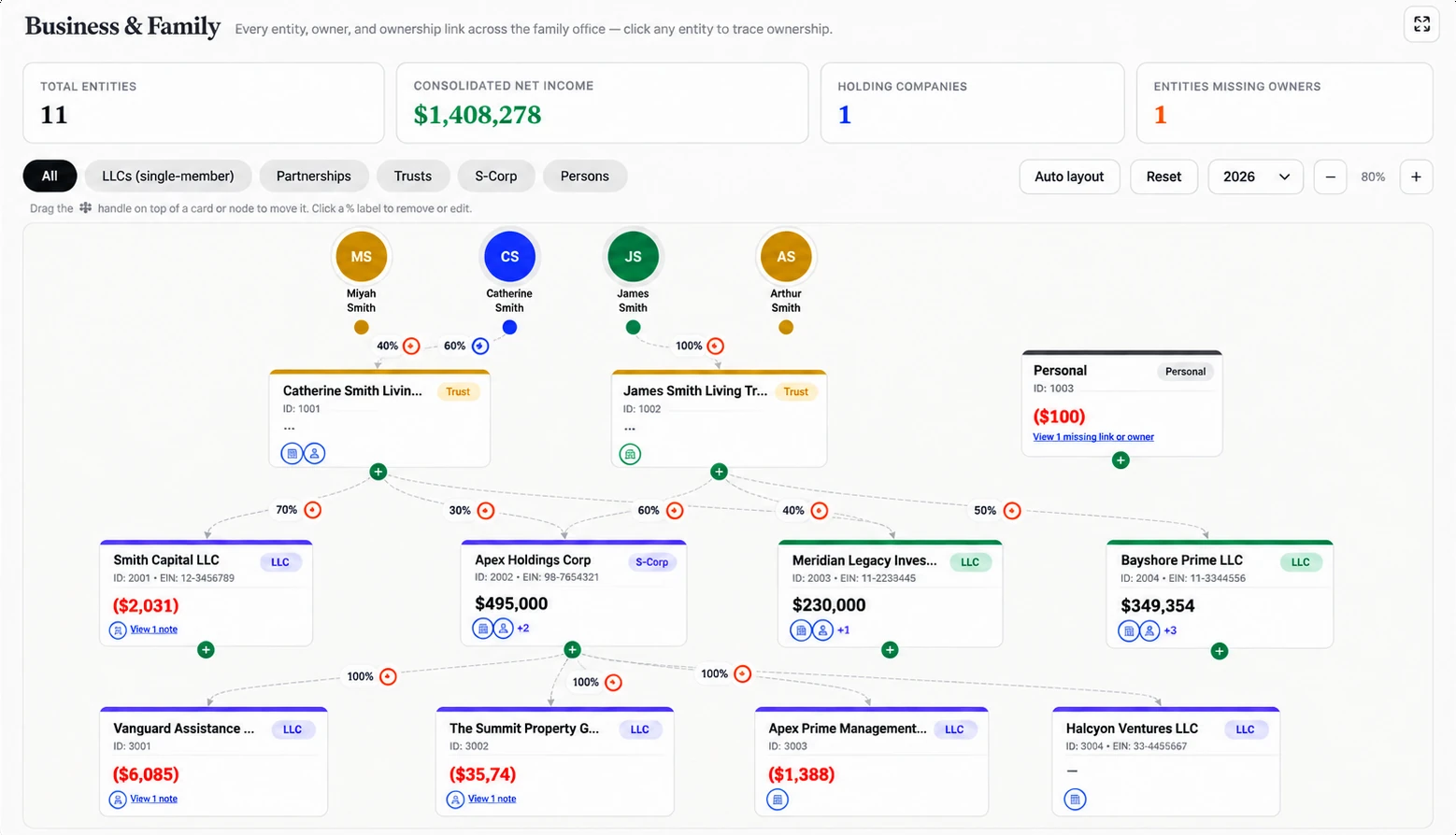
You see the custodied accounts. You do not see the four LLCs, the notes between them, the operating company that funds the contributions, or the trust that owns half of it. HaraPro holds that half, and gives you a window into it.
📚 Books for every LLC, S-Corp and trust your client owns
🏦 Every loan tied to the asset and the company behind it
📜 Trusts, wills, POAs and directives in the same system
What your portfolio system cannot see
The part of the client that is not a security.
A client with $40 million does not hold $40 million in a brokerage account. They hold an operating company, three real estate LLCs, a holding company above them, a trust that owns two of the LLCs, notes running in both directions, and a securities portfolio that your system reports on beautifully.
You see the last one.
When the client asks whether to take the distribution this year or next, whether the intercompany note should be forgiven, what the basis actually is in the company they are about to sell, or how the trust funding affects the estate, the answer lives in the part you cannot see. So it gets answered by the accountant, in April, from a folder of PDFs.
HaraPro is where that part lives. The client keeps it current because they use it for their own books, and you get read access.
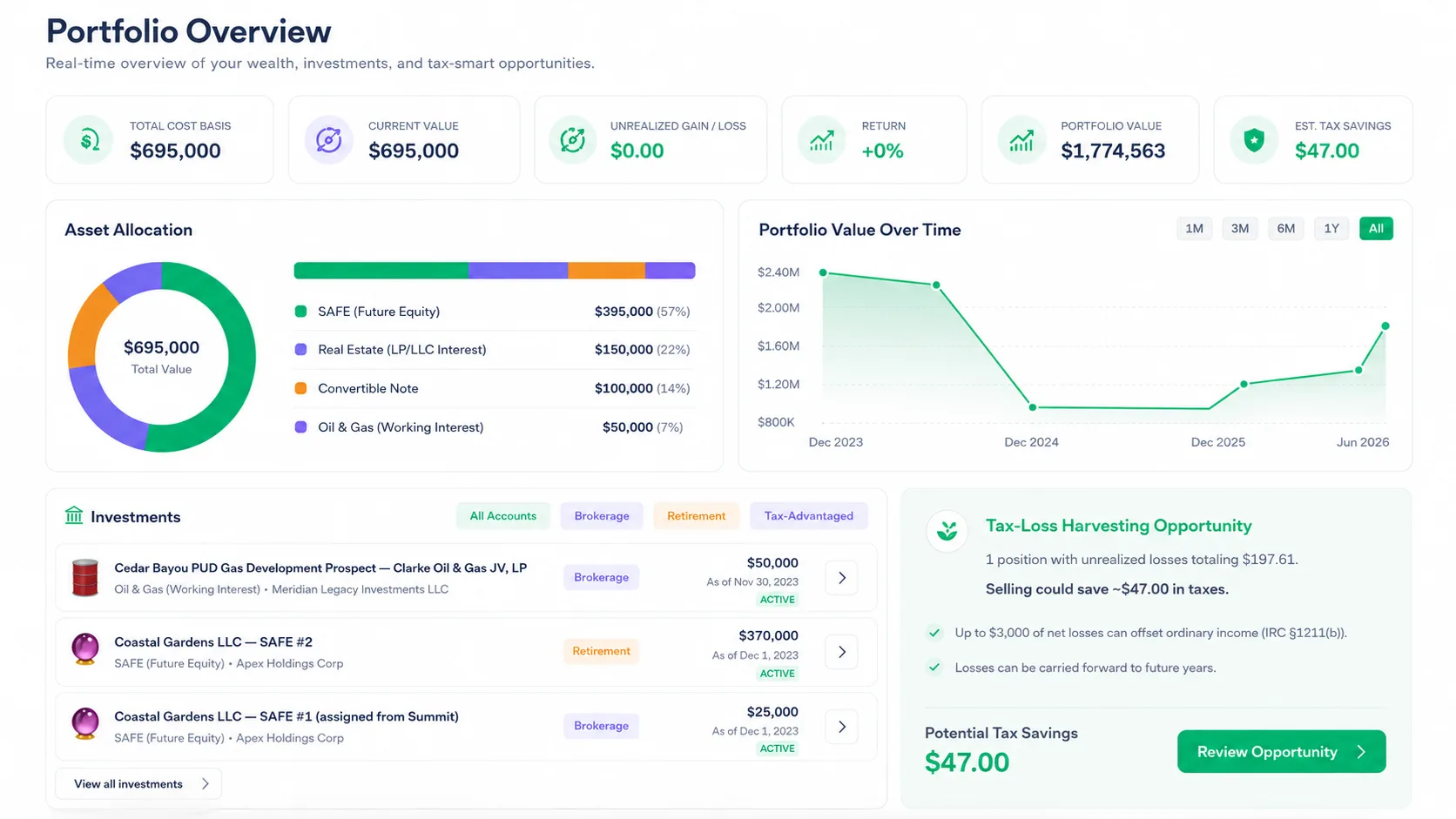
Addepar tells you what the portfolio did. This tells you what the client owns.
Before you go further
This does not replace your portfolio system.
HaraPro does not do portfolio accounting. No performance reporting against benchmarks, no custodial feeds, no capital call workflow, no fund-level partnership accounting. If you are looking for an Addepar, a Masttro or an Archway, this is not one and we are not going to pretend otherwise.
Keep the system you have. HaraPro sits next to it and covers what it was never built to cover: the operating businesses, the books, the loans between the client’s own companies, the live tax position, and the estate documents.
The firms that get the most out of this are the ones whose clients own businesses. If your book is all liquid, you do not need us.
The thing that does not exist anywhere else
Every payment, tied to the instrument it services.
A convertible note the client bought into. A SAFE from the round before. A loan the holding company made to the operating company. A mortgage on the building the S-Corp works out of.
In every other system these are a line in a spreadsheet, updated whenever someone remembers. In HaraPro an individual bank transaction attaches to the specific instrument it services. Principal splits from interest. The balance moves. The payment history builds itself.
The next time a client asks what the real return was on the note they funded four years ago, or what the balance is on the loan between two of their companies before they restructure, you answer from a system instead of from a request to their accountant.
How a firm runs it
The client keeps it current. You read it.
1
The client owns the data
They connect their own accounts and their own companies. Plaid covers 12,000+ institutions. Because they use it for their own books, it stays current without anyone chasing them.
2
You get a seat
Owner, admin, member and viewer roles. You take viewer or member on the accounts your clients give you access to. No screenshots, no emailed PDFs.
3
Their accountant gets the export
The CPA export package is built for the return. You stop being the middle of that conversation.
Pricing
Flat. Not basis points.
The category prices on assets. Addepar family office deployments commonly start around $50,000 a year plus implementation, with an average contract value around $229,000 and a rate of roughly one basis point. Masttro runs $50,000 to $150,000 a year. Those numbers buy portfolio accounting, which is a different product than this one.
For the firm
Partner
$499$199/mo
Then a flat rate per client: Starter $24.90, Pro $54.90, Unlimited $139.
A firm running Enterprise with forty clients pays less in a year than the entry point of a single family office deployment.
What a firm asks before it puts a client on this.
Are you SOC 2 certified?
Not yet. The SOC 2 Type II audit is in progress and we expect it to complete in Q4 2026. Today: AES-256 at rest, TLS 1.3 in transit, tenant-isolated storage, full audit logging, and bank connections through Plaid, which means we never see a credential. If your due diligence requires a completed SOC 2 report before onboarding, we are not there yet, and we would rather you hear that from us than find it in month three.
Does this replace Addepar or Black Diamond?
No. There is no performance reporting, no custodial feed and no capital call workflow. Keep what you have. This covers the operating companies, the books, the loans and the estate side, which those systems were not built for.
Who owns the client’s data?
The client. The account is theirs, they grant and revoke your access, and if they leave your firm the data goes with them. That is deliberate. It is the reason they keep it current.
Can we white-label it?
On Enterprise, yes.
What does onboarding a client actually take?
The client connects accounts and creates their companies. Most are through it in under thirty minutes. Nothing to install, no data migration project, no implementation fee.
What if the client’s businesses are complicated?
That is the case this was built for. Multiple LLCs, S-Corps, partnerships with K-1s, trusts that own other companies, notes running in both directions. The consolidated view sits on top of all of it.
What happens if we stop paying?
Your firm seat goes away. Your clients keep their accounts, on whatever plan they are on. We do not hold client data hostage to a firm contract.
See it on your own books first.
Open a free account, put one of your own companies in it, and decide from there. That is how every firm on this has started.