For estate planning attorneys

Draft the instruments where the assets already are.

Intake, the ownership structure, the account balances and the draft documents in one place. Your client builds the picture with you, on screen, and HaraPro generates the Trust, the Will, the POAs and the directives from what is actually there.

You review, adapt and execute. The draft comes out of the client's real balance sheet instead of a questionnaire.

Book a walkthrough, or start on your own. Free for 1 business · No credit card required · Drafting is on the Unlimited plan

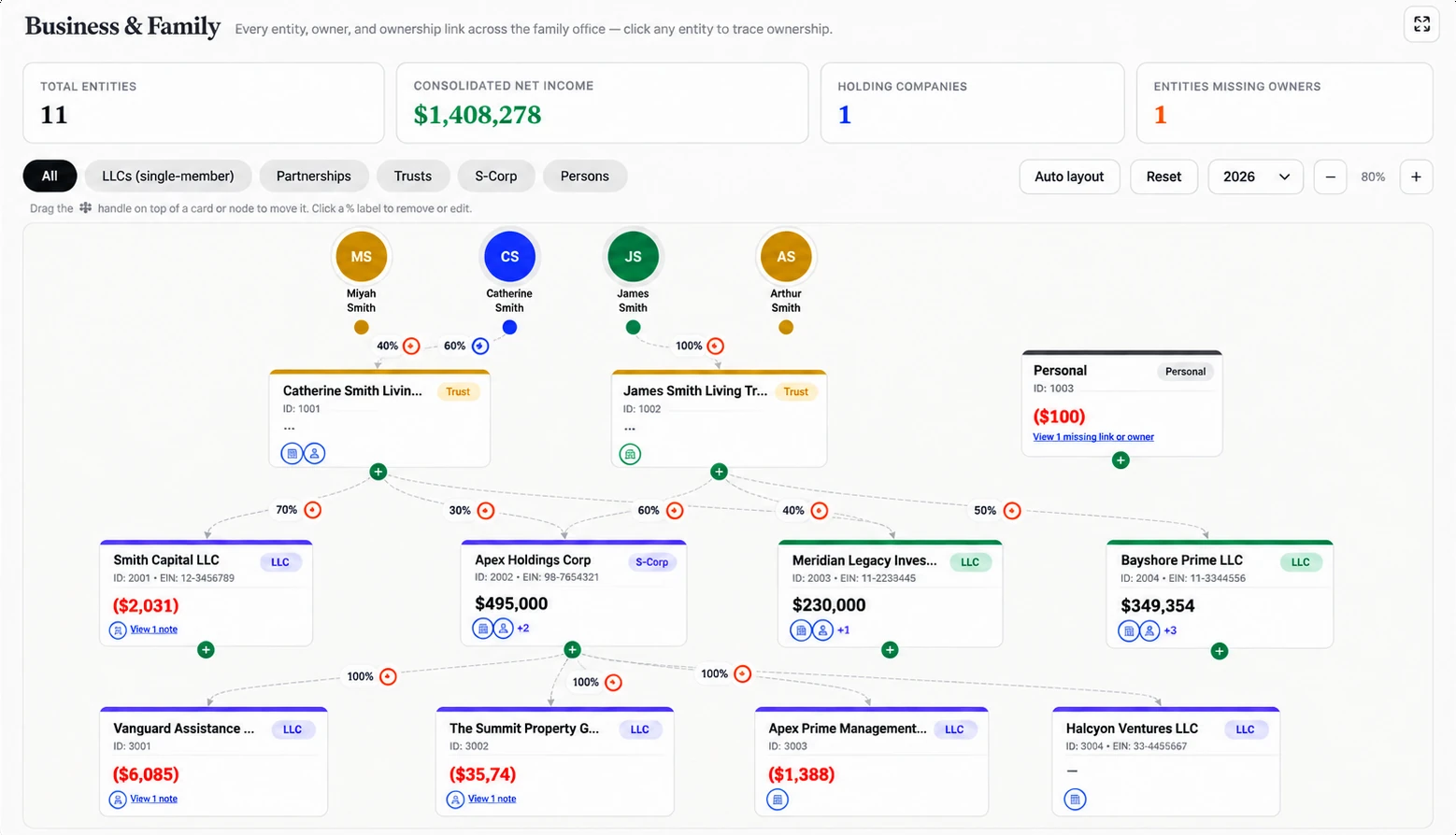
HaraPro Business and Family structure map showing trusts, LLCs, an S-Corp and individual owners with ownership percentages on every link
Every trust, business, owner and ownership link on one map, with net income per business and a live count of anything missing an owner. The client watches it take shape with you, and the instruments are drafted from it.
Where the plan is really decided

The intake is where the plan is decided, and it happens in a questionnaire.

You send a form. It comes back with a list of account names, three LLCs the client half remembers, a balance from last quarter and a note that there is "a property in Georgia". Then you build a plan on top of it.

The form is a memory test

The client answers from memory, once, under time pressure. You design against whatever they recalled that afternoon, and every gap in the form becomes a gap in the plan.

The structure only exists on your side

You can see the ownership graph. The client sees a document they are asked to sign and mostly trusts you on. The questions they should have asked arrive six months later.

Funding is a second project

The plan is signed and the retitling drags for months, because nobody ever had one list of what needed to move and who owned it today.

Step one, before you meet

The client connects, instead of remembering.

Bank connections or uploaded PDF statements. Businesses, trusts, holdings and the ownership between them. Loans and notes, including the ones between their own companies. It arrives as data, not as a recollection.

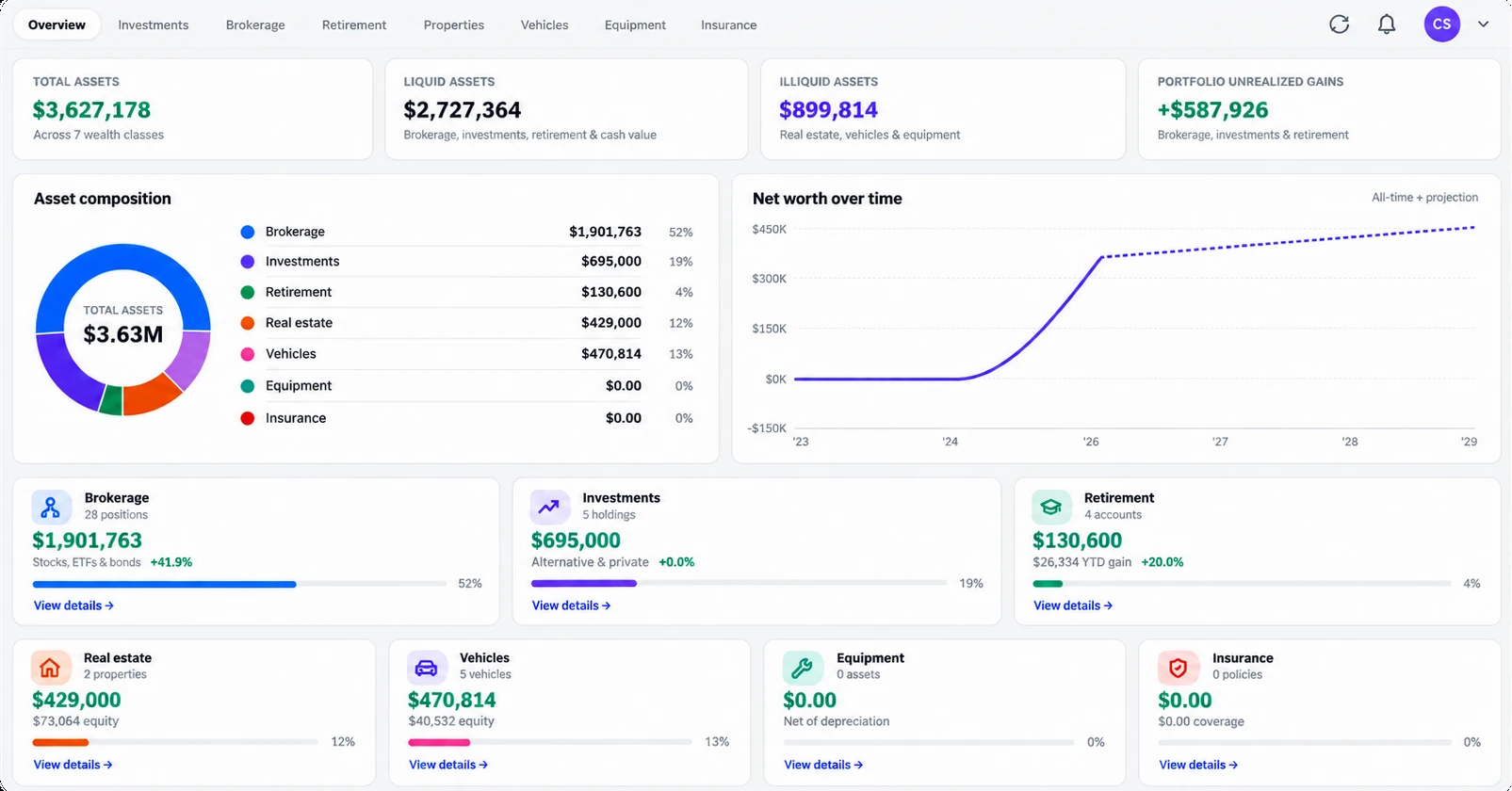
  • Total assets, and the split between what is liquid and what is not. The liquidity question every plan turns on, answered before you design against it.
  • Composition by asset class, so you can see what is real estate, what is in the market, and what is tied up in the businesses.
  • Net worth over time, from the client's own accounts rather than a figure they estimated on a form.
  • It stays current as the holdings change, so the picture you planned against is the picture that still exists at funding.
HaraPro assets overview showing total assets, the liquid and illiquid split, asset composition by class, and net worth over time
What no other platform in this category does

HaraPro drafts the instruments from the structure it just built.

Not a blank template you fill in again. The trusts, the will, the powers of attorney, the directives and the memoranda, generated against the assets, the ownership and the people already in the client's account.

01
The client's position is in
4 businesses 2 trusts
Accounts, holdings, notes and ownership percentages, connected rather than typed.
02
You design against it
On screen together
Corrections happen in the meeting instead of in a revision three weeks later.
03
The instrument is drafted
Trust draft ready
Real legal names, real addresses, real account detail. You review, adapt and execute.

For a revocable living trust the client can walk the guided setup themselves before you meet, so the first conversation starts from a draft instead of a blank page.

Your firm's language, not ours. Send us the clauses and the house style your practice uses and we build your templates into the account, so what comes out reads like your work because it is your work. Our team sets that up with you.
What it drafts

The full set, generated from the client's actual position.

  • Real names, real numbers. Legal names, addresses, account detail and ownership percentages come from the record, not from a placeholder you find later.
  • The schedules populate themselves. A personal property memorandum drawn from the assets already recorded, rather than a blank form the client fills in from memory.
  • Funding is visible while you draft. Which assets are inside the trust and which are not, on the same screen as the instrument.
  • Held afterwards in File Vault. Executed copies, full-text search, on every plan including Free.
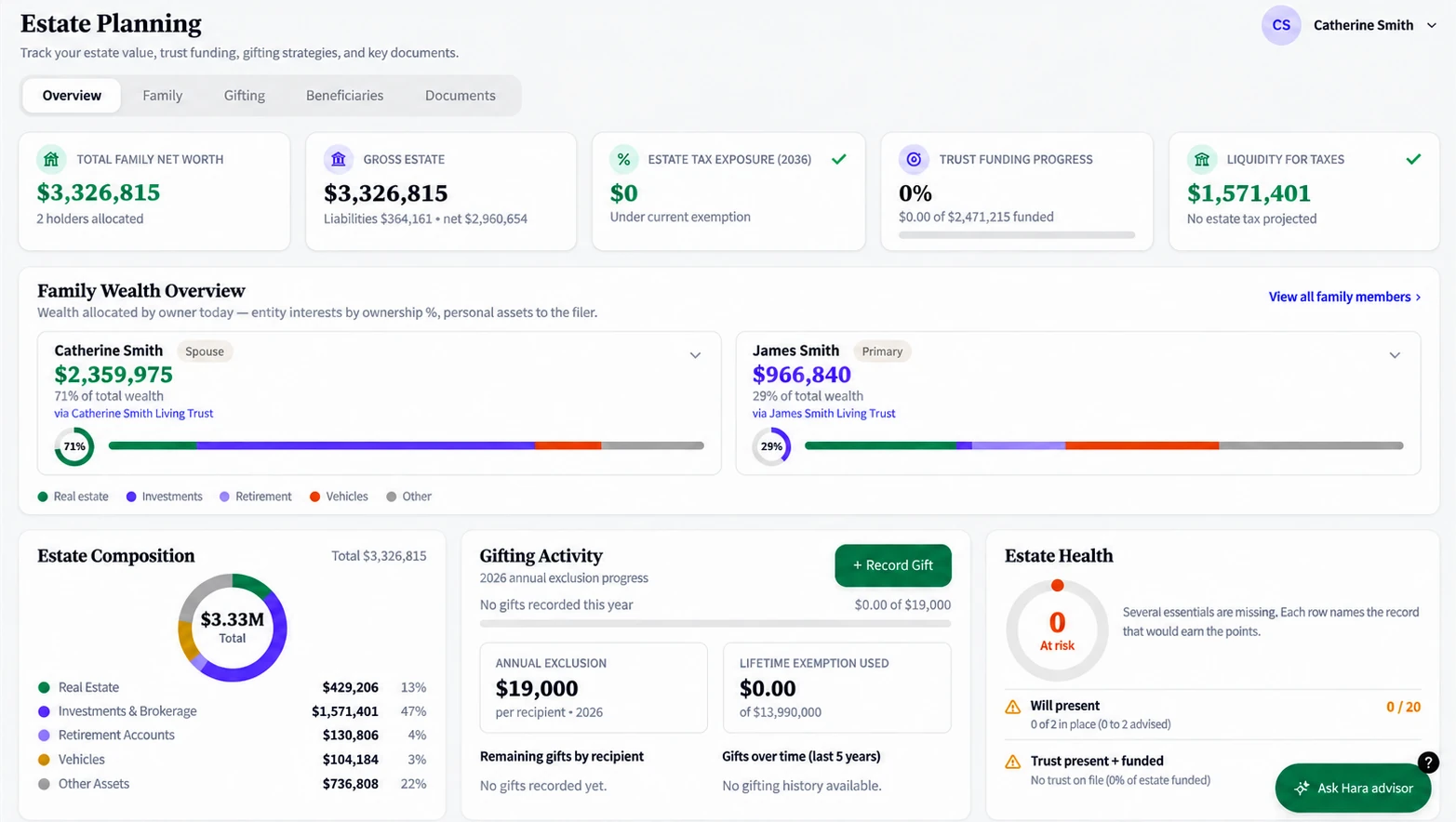
HaraPro Estate Planning overview showing family net worth, gross estate, estate tax exposure, trust funding progress, liquidity for taxes, estate composition and gifting activity
The complete set

Eighteen documents, and every one of them drafted from the client's own record.

Trusts
  • Revocable Living Trust
  • Irrevocable Trust
  • Irrevocable Life Insurance Trust (ILIT)
  • Grantor Retained Annuity Trust (GRAT)
  • Qualified Personal Residence Trust (QPRT)
  • Special Needs Trust
  • Charitable Remainder Trust
  • Charitable Lead Trust
  • QTIP Trust
  • Dynasty Trust
  • Testamentary Trust
Wills
  • Last Will and Testament
  • Pour-over Will
Schedules
  • Personal Property Memorandum
Incapacity
  • Durable Power of Attorney
  • Healthcare Power of Attorney
  • Healthcare Surrogate designation
  • HIPAA authorization
  • Living Will / Advance Directive
And the ones your practice writes its own way. Send us the clauses and the house style your firm uses and our team builds them in as your templates, so what comes out of the account reads like your work because it is your work.
Why clients sign faster

Your client understands the plan, because they watched it get built.

An estate plan is the largest financial decision most people ever sign, and they usually sign it having understood the summary rather than the structure. Here the client is looking at their own money while you explain what the Trust does to it.

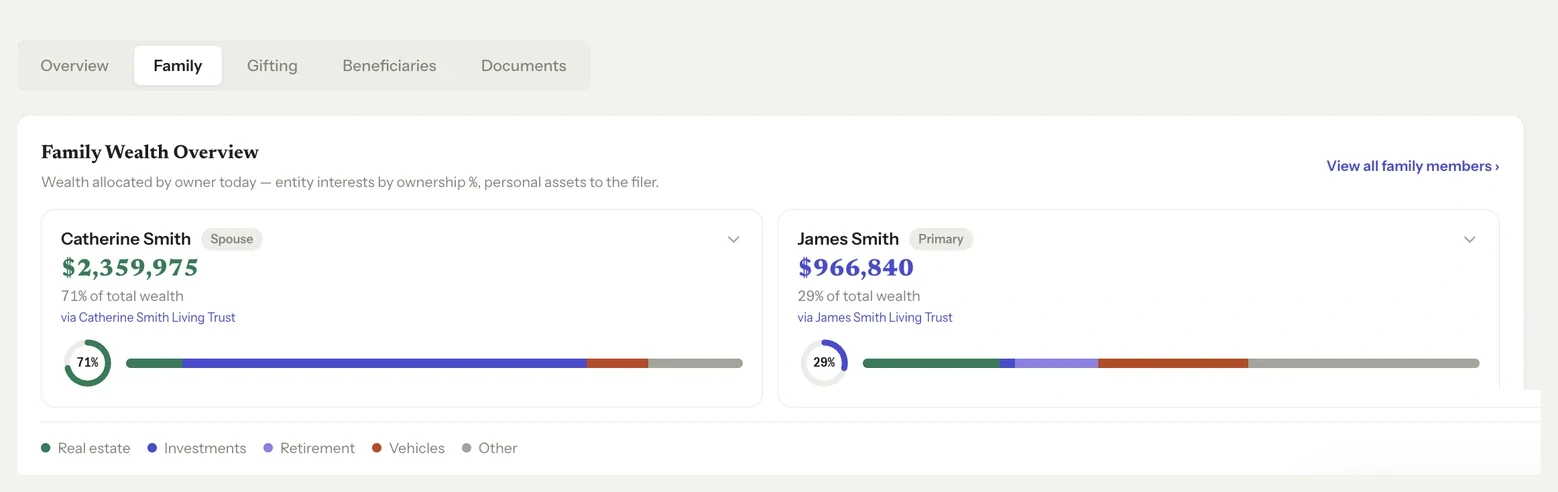
  • Wealth allocated by owner, today. Business interests by ownership percentage, personal assets to the filer, and the split between spouses on one screen.
  • Which living trust each side actually sits in, named on the card, so a funding gap is visible instead of assumed.
  • Each person's mix across real estate, investments, retirement and vehicles, so an imbalance between spouses is a picture rather than an argument.
  • Clients who understand the plan sign faster, refer more, and come back for the amendment instead of shopping for a new firm.
HaraPro Family Wealth Overview showing wealth allocated by owner, each spouse's share of total wealth, the living trust it sits in, and the mix across real estate, investments, retirement and vehicles
After signing

Eighteen months later, the plan is still observable.

Your drafting does not decay. The client's behaviour does. The intercompany note gets no payment history. The businesses start running out of one checking account. Nobody can say which distribution came from which instrument.

HaraPro links individual bank transactions to specific loan instruments. When the operating LLC pays down an intercompany note, the payment attaches to that note, the balance moves, and the payment history builds itself. Checked against Mint, Monarch, YNAB, Copilot, Empower, Kubera and Intuit Lacerte: none of them do it. When the client comes back to amend, or when someone questions the structure, the record is already there.

Where the line sits.

HaraPro generates documents. You decide what the plan should be, review every instrument it produces, adapt it, and take responsibility for it. That is the same line every document assembly tool in your practice already sits on.

What HaraPro does
  • Collects the client's real assets, businesses and ownership
  • Shows the structure to you and the client at the same time
  • Drafts the trusts, wills, POAs, directives and memoranda
  • Builds your firm's templates and clauses into the account
  • Keeps notes, payments, gifting and distributions on the record
What HaraPro does not do
  • Design the plan
  • Give your client legal advice
  • Practise law in any form
  • Replace your judgment on any of it
Partner Program

Your practice, your branding, every client's structure in one place.

You pay a base subscription for the firm, then a flat rate for each client you put on the platform. There is no revenue share and there is nothing for you to sell.

  • White-label. Your practice's branding on the environment your clients log into.
  • Every client's structure in one place. Bulk management across the families you serve, rather than one login at a time.
  • Per-client control. Decide what each client sees and can change.
  • Your templates, built in by our team. The clauses your firm uses, in the account, before your first client touches it.

Per client, billed to the firm on top of your base fee: $24.90 Starter, $54.90 Pro, $139 Unlimited. Estate planning and document drafting sit on the $139 plan. What you charge the client, or whether you absorb it, is your decision and not something we get involved in.

Partner
$499/mo
or $4,989/yr · save 17%
Book a walkthrough Start Free

Enterprise is $999/mo or $9,989/yr for multi-location firms, and adds white-label.

FAQ

What you are probably about to ask.

Are you trying to replace what I do?

No. HaraPro generates documents from the client's data and your templates. It does not decide what the plan should be, it does not advise your client, and nothing it produces goes anywhere without your review. What it replaces is the questionnaire, the retyping and the reconstruction.

Whose language do the documents use?

Yours, once we have set it up. Send us the clauses and the structure your firm uses and our team builds them into your account as your templates. Out of the box it uses standard forms.

My client already has a CPA and a bookkeeper. Why this?

Because neither of them is looking at the estate structure. The CPA files the return, the bookkeeper closes the month, and the ownership graph the plan depends on lives in your file and nowhere else. This is the one place all three are true at once.

Who enters all of this?

The client, before the meeting. Bank connections come in through Plaid, or statements are uploaded as PDFs, either way. If they get stuck, we walk them through it.

What does it cost my client?

Nothing, if the firm carries it. $139 a month to the firm for a client on the plan that includes estate and drafting. On their own account, free for one business, $79/mo Pro, $199/mo Unlimited. Firms handle that differently and we do not have a view on it.

Where do the executed documents live?

In the client's account, in File Vault, with full-text search, sitting beside the structure they govern. On every plan, including Free.

Where does the data live, and how is it secured?

Encrypted at rest and in transit, US infrastructure, and a full encrypted export at any time. SOC 2 Type II audit in progress, Q4 2026 completion.

Can I see it before I put a client near it?

Yes. Build a structure in it yourself on the free plan, or take the 20-minute walkthrough and we will build one with you.
Build a structure in it before you decide.

Twenty minutes, your screen, a real client structure rather than a demo account. If it is not for your practice you will know inside ten.

Questions? rafael@harapro.com